
About the Project
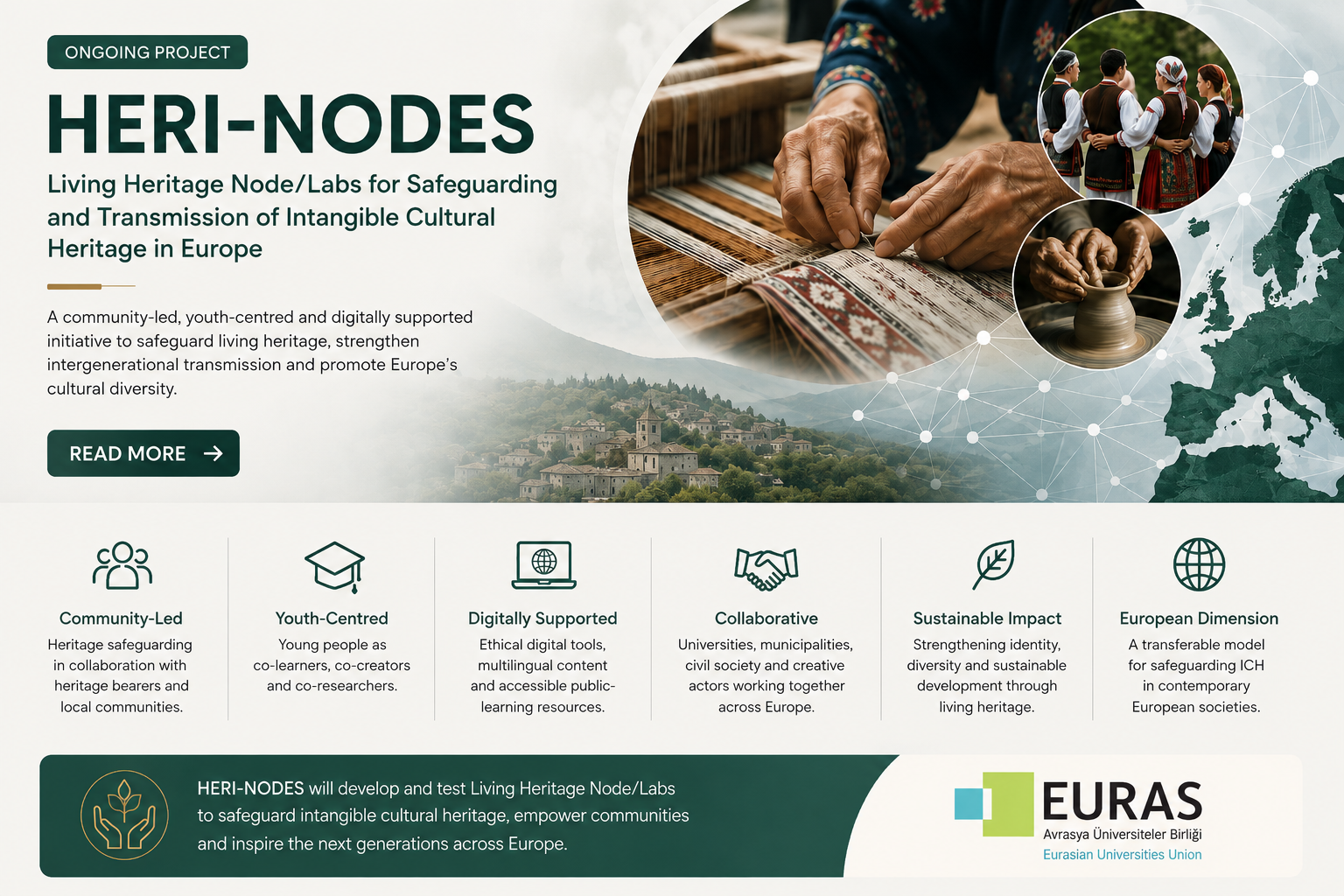
HERI-NODES responds to the growing need to safeguard living cultural practices that are increasingly vulnerable to demographic change, rural depopulation, urbanisation, migration, environmental pressures, digital homogenisation and the weakening of informal transmission spaces. The project will explore how universities, municipalities, civil society organisations, young people, digital tools and public-learning environments can work together to strengthen the transmission of intangible cultural heritage in contemporary Europe.
Overall Objective
The overall objective of HERI-NODES is to develop, test and disseminate a community-led, youth-centred and digitally supported model for safeguarding and transmitting intangible cultural heritage in Europe. The project aims to generate comparative evidence on intergenerational transmission, community ownership, ethical documentation, youth participation, digital access, biocultural heritage awareness and policy innovation.
Core Concept: Living Heritage Node/Labs
HERI-NODES is built around the idea that safeguarding intangible cultural heritage requires functioning transmission environments, not documentation alone. A Living Heritage Node/Lab is conceived as an experimental safeguarding environment where heritage bearers, young people, researchers, municipalities, civil society organisations and community actors work together to test how living heritage can be transmitted, interpreted and sustained in contemporary contexts.
Each community-linked Node/Lab is expected to work with a curated set of three heritage elements: two UNESCO-inscribed or officially recognised elements and one endangered or under-recognised non-listed practice identified through community consultation.
Key Objectives
- Establish a comparative evidence base on intangible cultural heritage safeguarding and transmission in Europe, with reference to the UNESCO 2003 Convention.
- Develop and test Living Heritage Node/Lab models in university-based, municipality-linked and NGO / entrepreneurship-centred environments.
- Strengthen youth-centred and intergenerational transmission by involving young people as co-learners, co-creators and co-researchers.
- Develop ethical digital tools, multilingual content, destination-linked micro-content and public-learning resources.
- Produce a transferable Living Heritage Transmission Framework, policy recommendations and replication tools for wider European uptake.
Heritage Discovery Clusters
Selected heritage elements will be organised into thematic Heritage Discovery Clusters to help connect living heritage with identity, ecology, memory, skills, place and transmission.
- Route-Based Biocultural Heritage Discovery
- Foodways, Seeds and Seasonal Practices
- Craft Materials and Sustainable Making
- Water, Landscape and Traditional Ecological Knowledge
- Oral Traditions, Music and Ecological Memory
- Endangered and Under-Recognised Living Heritage
Consortium Development
The consortium structure is currently under development. The project is expected to bring together a balanced partnership of universities, civil society organisations, municipalities, cultural heritage actors, an accredited intangible cultural heritage NGO, a digital technology partner and a strategic cultural outreach partner.
Additional partners from different European countries are being invited to strengthen the scientific, methodological, local pilot and safeguarding dimensions of the project. Relevant expertise may include ICH governance, living heritage, sustainability, cultural anthropology, digital cultural heritage, community-based research, youth and community engagement, local pilot implementation and safeguarding methodology.
Work Packages & Main Activities
WP1 – Project Governance, Ethics, Community Consent and Quality Assurance
Project management, ethical governance, community consent, data governance, youth safeguarding, quality assurance and risk management.
WP2 – European State-of-Play, Pilot Design and Core Learning Framework
Mapping ICH safeguarding and transmission in partner contexts, identifying pilot environments and heritage cases, and developing a shared Core Learning and Safeguarding Framework.
WP3 – Comparative Piloting of Living Heritage Node/Lab Environments
Testing university-based, municipality-linked and NGO / entrepreneurship-centred Node/Lab models, together with a mobility-based cultural outreach and passenger engagement pathway.
WP4 – Youth Co-Creation, Advanced Digital Documentation and Heritage Content Development
Youth co-creation and co-research, ethical documentation, digital storytelling, multilingual content, mobile learning tools, digital repository models and AI-supported translation/subtitling workflows.
WP5 – Comparative Evaluation, Policy Development, Dissemination and Replication
Comparative evaluation, policy recommendations, a Living Heritage Transmission Framework, and dissemination and replication tools for wider uptake.
Expected Results
- Comparative analysis of intangible cultural heritage safeguarding and transmission in Europe
- Tested Living Heritage Node/Lab models
- Community-based safeguarding and consent methodology
- Youth co-creation and intergenerational transmission models
- Ethical digital documentation and multilingual content packages
- Mobile application and digital repository prototypes
- Destination-linked living heritage micro-content
- Policy recommendations and safeguarding guidelines
- A transferable Living Heritage Transmission Framework
- A practical replication toolkit for municipalities, universities, civil society organisations and heritage communities
Expected Impact
HERI-NODES is expected to strengthen community ownership of intangible cultural heritage, support intergenerational transmission, increase youth participation, improve recognition of under-recognised heritage practices and encourage the ethical use of digital tools in safeguarding. The project also aims to strengthen cooperation among universities, municipalities, civil society organisations, cultural heritage actors, technology partners and public communication stakeholders.
Current Status
The project concept and consortium structure are currently under development. Potential partners are being invited to discuss their possible role, contribution and interest in joining the consortium. The concept will continue to be refined together with interested partners as the project development process progresses.